
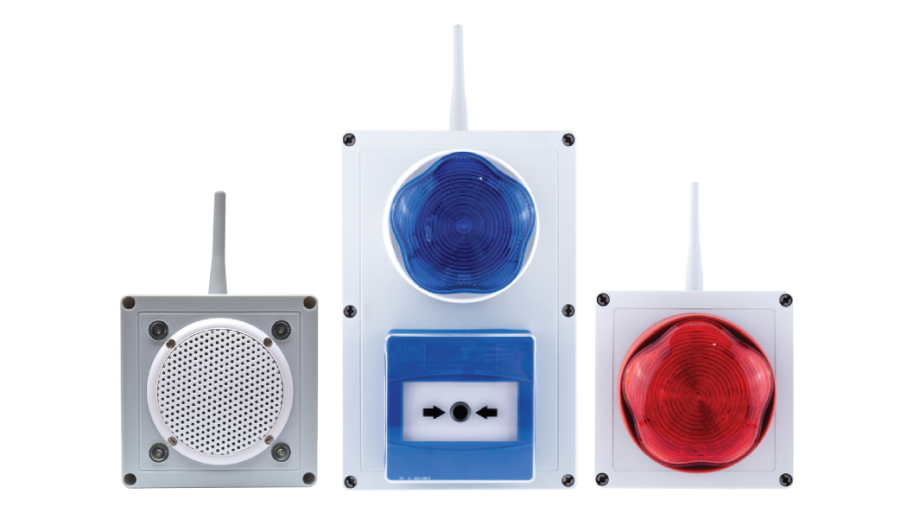
Wireless Critical Alert System
Battery-powered with a wireless range of up to 1km, the Alertex system is the perfect standalone solution for a variety of applications
What is a Lockdown?
All schools must have a Lockdown policy in place that outlines their action plan for the restriction of movement during an emergency situation. A lockdown policy aims to
prevent people from freely entering, leaving, or moving around an area to minimise disruption and danger.
In line with OFSTED guidance the Lockdown system should provide an audible and/or visual alert that is specific to a scenario requiring free movement to be restricted. The Lockdown system should look and sound different to a fire alarm, and should provide a clear alert swiftly and reliably.
How does the Alertex Wireless Lockdown System work?
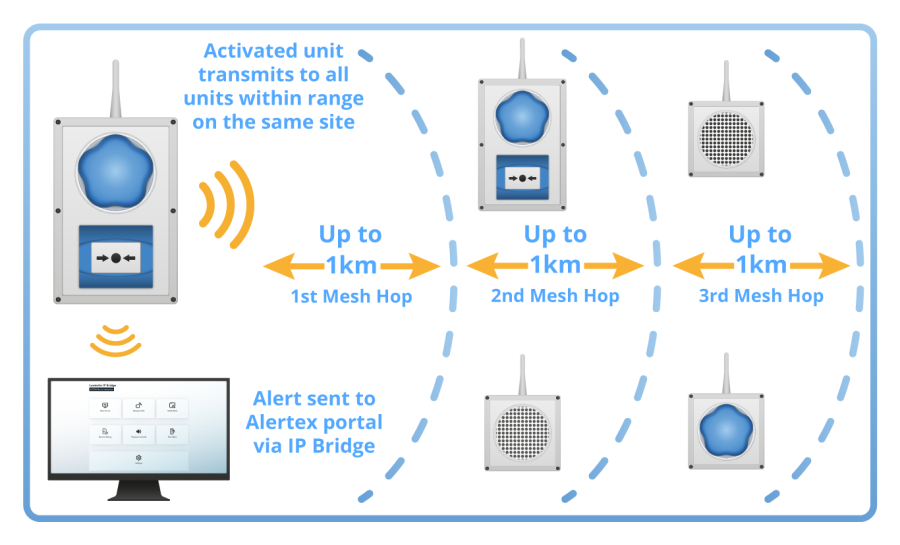
The Alertex Wireless Critical Alert System forms an interconnecting wireless mesh network between all units on the same site code. When one unit is activated, it will activate all other units on the
same site. The maximum line of sight wireless range for Alertex units is 1km, and units can be set to repeat the signal, which in turn extends the wireless transmission range.
The Alertex system can be activated by any call-point or key fob within range of a main unit, or remotely from a central location using the Alertex web portal and IP bridge.
The system is fully standalone and requires no wires or cabling. Units are battery-powered with a long battery-life of up to 2-years.
Why do you need a Lockdown system?
An emergency Lockdown System is now an essential part of any preparedness plan for institutions with a duty of care to students, staff, and the general public. As a Lockdown scenario requires a
different response to a Fire scenario, using a dedicated Lockdown System is preferred, as outlined in the ‘Evacuation, invacuation, lockdown, protected spaces’ guidance provided by NaCTSO:
“In some emergency scenarios such as a terrorist attack, the appropriate response may be not to evacuate. Where evacuation may be required, the evacuation response may differ to that of a fire. For example, people may be directed to specific exits or to avoid a particular route or area.
For this reason, it is suggested the activation of the fire alarm to initiate evacuation should be avoided to reduce the possibility of an incorrect response. Public Address (Tannoy) systems, if available, may provide more flexibility to provide information and instructions appropriate to the scenario and to provide positive confirmation to staff and visitors that the emergency is real. This will help to reduce any potential delay in response.”

Sounder Beacon Range
GFSS alertex-datasheet sounder beacons.p[...]
Adobe Acrobat document [651.9 KB]
Manual Call Point Range
GFSS alertex-nxecp-datasheet MCP.pdf
Adobe Acrobat document [989.6 KB]
Call 01983 869010 or Email: sales@guardianfss.co.uk for a free site survey
 Print
Print 